
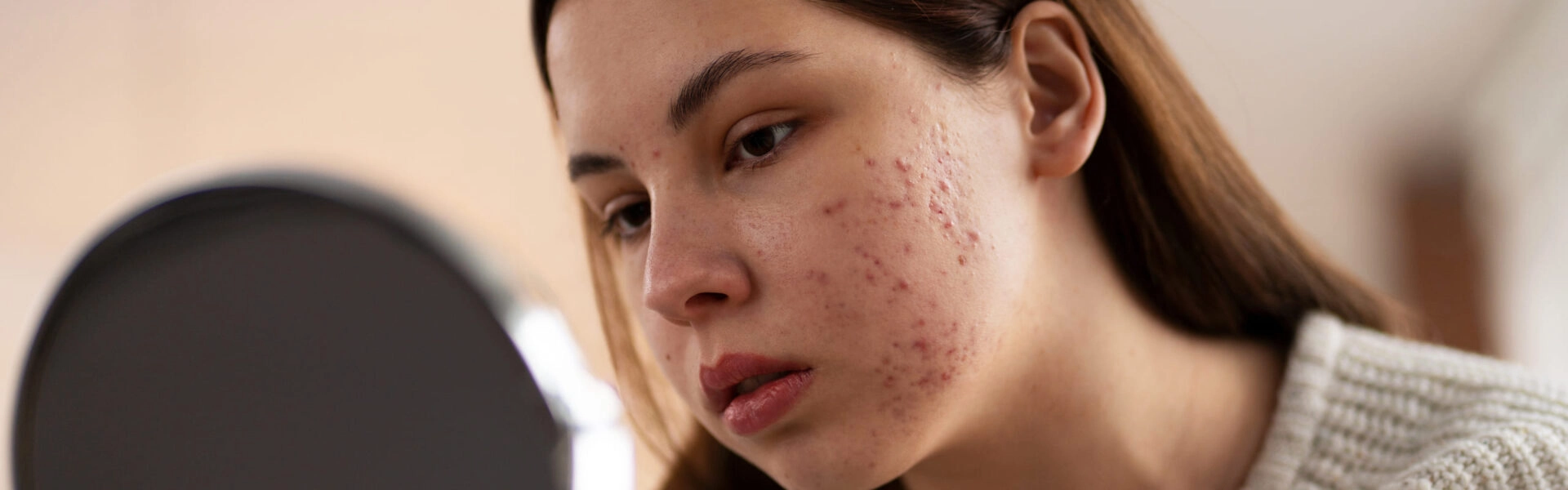
What Are the Different Types of Spots?
Acne is a skin condition affecting the pilosebaceous follicles, where hair grows and where sebum, a natural oily substance, is secreted to hydrate and protect the epidermis.
Hormonal changes, excess sebum production and several other lifestyle-related factors (stress, diet, unsuitable hygiene...) contribute to its appearance. There are various manifestations and causes of acne, resulting in several types of spots: red or white spots, blackheads, small bumps or larger lumps...
Each of these spots has a scientific name, specific characteristics and particular mechanisms of formation: sebum retention, inflammation, infection, and so on. Let's review them!
A Closer Look at the Different Types of Spots
Open Comedones, or "Blackheads"
Open comedones, commonly known as "blackheads", develop when the pilosebaceous follicles produce too much sebum and their canal is too narrow for the sebum to flow normally.
The pilosebaceous follicle then becomes clogged with thickened sebum and dead keratin cells, a protein that makes up the skin and hair. Its external opening at the epidermis shows a rounded, firm "plug" that is dark in colour: black, brown or grey. This plug is made up of melanin cells, the skin's dark pigment, and oxidised keratin. The skin around the comedone is normal.
Acne often starts with the appearance of tiny blackheads on oily areas of the skin, such as the nose. As it progresses, these small blackheads can grow larger as the canal of the pilosebaceous follicle widens with the thickening of the sebum. They can then reach 1 to 3 mm in diameter.
Closed Comedones, or Microcysts
Closed comedones or microcysts, more simply called "whiteheads", are a variant of the blackhead.
Indeed, a closed comedone also contains thickened sebum and keratin, but the external opening of the pilosebaceous follicle canal is covered by skin. The skin bulges slightly under the effect of sebum secretion, allowing it to show through. This gives the microcyst its appearance of a small, hardened, smooth spot that is white, pale or pinkish in colour, often surrounded by a redder halo. If the follicle containing the microcyst becomes weakened, it can become infected: the microcyst then turns into a pustule, or even a nodule.
Good to know: open or closed comedones are characteristic of what is known as "retentional" acne, since there is retention — rather than outflow — of sebum, without inflammation.
Papules, or "Red Spots"
Papules are inflamed spots that can develop on skin with no visible blemish or on micro-comedones.
They appear as swollen, red spots around 1 to 4 millimetres in diameter (no more than 1 cm), which can be painful due to the inflammation. There is no visible centre, unlike microcysts or pustules.
The inflammation of papules is linked to the presence of a bacterium, Propionibacterium acnes (also known as Cutibacterium acnes) or P. acnes. This bacterium feeds on the fatty acids in skin sebum, sometimes made worse by rubbing, picking at, or squeezing a comedone or an emerging spot.
Pustules, or "White Spots"
When papules become more inflamed, are scratched and/or when P. acnes and other bacteria proliferate within the pilosebaceous follicle, they can become infected.
The follicular canal then fills with pus, an opaque fluid containing bacteria and immune cells: these spots are pustules. Pustules are very red, slightly swollen, and often show a white or yellowish tip on the surface of the skin. They can be painful to the touch.
Nodules and Cysts
When pilosebaceous follicles become enlarged, blocked and infected, they can release fatty acids, inflammatory substances and bacteria into the surrounding dermis. They increase in size under the skin, forming firm, red bumps of 5 mm to 1 cm known as nodules.
Cysts are the "XL" version of microcysts. Red or skin-coloured, they also form bumps that are soft to the touch, but softer than nodules. They contain sebum, dead cells and pus enclosed within a solid fibrous shell. Cysts therefore do not rupture spontaneously, unlike nodules.
Nodules and cysts can form from several infected pilosebaceous follicles merging together. Because they develop deep within the skin, these types of spots are often painful and more difficult to treat.
Good to know: papules and pustules are characteristic of what is known as "inflammatory" acne, also called "papulopustular" acne. Acne presenting with nodules or cysts is considered severe and can leave scars: at this stage, it is advisable to consult a dermatologist.
Acne can present as one or several types of spots which often progress, on oily skin, from a retentional stage, with comedones, to an inflammatory stage, with papules and pustules.
These different types of spots can be present on the skin at the same time, but each requires specific care. They can multiply or worsen over time into cysts and nodules if the P. acnes infection is not controlled.
It is therefore important to look after your skin by opting for targeted treatment of blemishes as soon as they appear.